Artificial intelligence is changing the legal profession, but technology cannot replace the relationship between an attorney and a client. At Chalat Hatten & Banker, we believe technology should enhance the work of an experienced attorney, not replace the judgment, preparation, advocacy, and personal connection that our clients depend on.
Knowing Our Clients Comes First
As lawyers, we are here to perform uniquely human tasks that are not well-served by artificial intelligence. Our primary duty is to know our client – their particular needs, their injuries, and their desired outcomes – and offer guidance to help achieve their goals. Knowing one another in a relationship of trust can never be replaced by technology.
We are persuasive writers, orators, and negotiators. Creative and convincing writing is a skill that must be maintained through practice. By regularly exercising this muscle ourselves, and not ceding our abilities to AI, we maintain, improve, and refine our skills to best serve our existing and future clients.
Understanding Every Detail of a Client’s Case
As humans, we learn through reading and writing. By reading and summarizing our client’s case files ourselves, we best serve our clients by gaining a mastery of the facts of each case, and not risk missing a subtle but important detail that an AI model deems irrelevant.
When we are called upon to speak for our clients, whether to an insurance adjuster by phone or to a judge and jury in a courtroom, the facts of the case and client’s needs must be foremost in our minds. By putting in the time to do the underlying work by hand, we are best equipped to speak persuasively and knowledgeably on behalf of our clients.
Using AI When It Benefits Our Clients
We embrace technology, including artificial intelligence, only when it benefits our clients.
AI can be a powerful tool to help us identify the best caselaw so we can present the strongest arguments for our clients. It can be used as a proofreader or search tool to pull key information from voluminous records when the human guiding it knows what they are searching for. AI can be leveraged to create a counterargument that serves as a check on our human biases.
AI Can Help the Lawyer, It Cannot Be the Lawyer
We know the limitations of technology. AI merely predicts language. It does not reason or think through policy or legal consequence. As a result, AI-generated work can sound polished while still being subtly wrong, incomplete, or based on incorrect assumptions. Where AI is used, results are diligently fact-checked. AI can be used to help the lawyer, it cannot be the lawyer.
At Chalat Hatten & Banker, technology may change the tools attorneys use, but it does not change our responsibility to our clients. Personal injury cases are ultimately about people, their health, their families, their livelihoods, and their futures. Our attorneys remain personally involved in understanding each client’s story, preparing their case, and advocating for the outcome they deserve.
RTD is a public entity, so transit injury claims run under the Colorado Governmental Immunity Act rather than ordinary tort rules.
Written notice must reach the correct entity within 182 days of discovering the injury under C.R.S. 24-10-109. Missing it bars the claim.
Damages are capped at $505,000 per person and $1,421,000 per occurrence for claims accruing on or after January 1, 2026.
You do not have to be in a collision to have a claim. Falls during sudden stops, boarding injuries, and hazards at stations and platforms can each support one.
When a private company operates service under contract, the correct defendant and the correct deadline may both be different, which has to be determined early.
Can you sue RTD after a bus or train accident?
You can, within the framework the Colorado Governmental Immunity Act sets. The Regional Transportation District is a public entity, which means the general shield against tort liability applies unless the claim falls into one of the categories where the legislature waived it.
Two waivers matter most for transit claims. The first covers the operation of a motor vehicle owned or leased by a public entity and driven by a public employee in the course of employment, which reaches bus collisions and injuries to passengers on board. The second covers dangerous conditions of public buildings and certain public facilities, which can reach injuries at stations, platforms, and transit centers.
If a claim does not fit a waiver, immunity applies and the case ends there. Determining which waiver applies is the first analytical step, and it shapes everything that follows.
What is the deadline for an RTD claim?
182 days from discovering the injury, and it is unforgiving. C.R.S. 24-10-109 requires written notice within that window, filed with the governing body of the public entity or the attorney representing it.
The notice must contain specific content set by statute: the claimant’s name and address, a concise statement of the factual basis including date, time, place, and circumstances, the name and address of any public employee involved if known, a concise statement of the nature and extent of the injury, and a statement of the monetary damages requested.
After filing, a lawsuit cannot be commenced until the entity denies the claim or ninety days pass, whichever comes first. That built-in waiting period is another reason the notice needs to go out early rather than at day 180.
Colorado courts have applied the deadline strictly, and have placed the burden on claimants to investigate rather than wait. The broader framework is covered in injured by a government vehicle in Colorado.
How much can you recover in a transit injury claim?
Recovery is capped by statute, and the applicable figure depends on when the claim accrued. Per the Colorado Secretary of State’s certified limitation on judgments, claims accruing on or after January 1, 2026 and before January 1, 2030 are limited to $505,000 for injury to one person in a single occurrence and $1,421,000 where two or more people are injured, with no individual recovering more than $505,000.
The multi-person figure matters in transit cases more than in most. A bus collision can injure a dozen passengers at once, and the per-occurrence limit is shared among them. That dynamic makes documenting the severity of an individual injury more important, not less.
Comparative fault applies on top of the cap. Under Colorado’s modified comparative negligence rule, an injured person found 50 percent or more at fault recovers nothing, and any award is reduced by their percentage.
What kinds of transit injuries lead to claims?
More than collisions. Public transit produces injury patterns that do not exist in ordinary vehicle cases, largely because passengers are standing, boarding, or moving through a station when the injury happens.
Bus collisions with other vehicles, cyclists, or pedestrians
Sudden stops and hard acceleration that throw standing passengers into stanchions, seats, or the floor
Boarding and alighting injuries, including doors closing on passengers and falls from the step
Wheelchair lift and securement failures
Light rail crossing collisions with vehicles or pedestrians
Platform and station hazards, including ice, uneven surfaces, and inadequate lighting
Assaults where inadequate security is alleged, which is analyzed under different principles than a vehicle claim
Does a transit operator owe passengers a higher duty?
Colorado law has historically recognized that carriers transporting passengers for hire owe a heightened duty of care compared to an ordinary driver. The reasoning is straightforward: passengers surrender control over their own safety when they board.
In practice this means an operator’s conduct is measured against a demanding standard, and questions about pulling away before passengers are seated, stopping short of the curb, or accelerating into traffic carry more weight than they would between two private drivers.
Whether and how that standard applies in a particular case is a legal question worth having evaluated. It does not change the notice deadline or the damage cap, both of which apply regardless.
What evidence matters in an RTD claim?
Transit systems generate a great deal of it, and much of it has a short retention window.
Onboard video. Most transit vehicles carry multiple cameras. Footage is typically overwritten on a cycle, so a written preservation demand needs to go out immediately.
Station and platform video for injuries that did not occur on the vehicle.
Vehicle telematics, including speed, braking, and door operation.
Incident reports prepared by the operator and by supervisors who responded.
Operator training and disciplinary records.
Maintenance records for the vehicle, the lift, or the door mechanism involved.
Prior incident history at the same location or involving the same equipment.
Public entities are subject to open records laws, which can provide a route to some of this material that does not exist for a private company. That access does not substitute for the notice of claim, and pursuing records is not the same as preserving the claim.
What if a private company was operating the service?
This is the question that most often changes the answer, and it needs to be resolved at the outset. Transit agencies contract portions of their service to private operators, and a private contractor may not qualify as a public entity.
If the operator is private, ordinary tort rules may apply instead: no statutory cap, and a three-year filing deadline under C.R.S. 13-80-101(1)(n) rather than a 182-day notice period. If the operator is public, or if the agency itself is implicated through vehicle ownership or contractor selection, the Governmental Immunity Act framework applies.
Because getting this wrong in either direction is costly, the practical approach is to identify the operating arrangement quickly and preserve the claim under whichever framework has the shorter deadline. Sorting out which entities are actually responsible is the same exercise described in who is liable in a truck accident besides the driver.
Written notice must be filed within 182 days after the date you discovered the injury, under C.R.S. 24-10-109. This deadline is much shorter than the three-year period for filing most personal injury lawsuits in Colorado.
Can I bring a claim if I fell on a bus without a collision?
Yes. Injuries from sudden stops, hard acceleration, doors, and lift failures can support a claim, and no collision is required.
How much can I recover?
For claims accruing on or after January 1, 2026 and before January 1, 2030, the statutory limit is $505,000 for injury to one person in a single occurrence and $1,421,000 where two or more people are injured.
Is the video from the bus available to me?
Not automatically. Onboard footage is typically overwritten on a cycle, so a written preservation request needs to be made quickly to keep it from being lost.
What if I was hit by a bus while walking or cycling?
The same Governmental Immunity Act framework applies, including the 182-day notice requirement and the statutory damage cap. You do not need to have been a passenger.
Does the cap apply if several passengers were hurt?
Yes, and the per-occurrence limit is shared among everyone injured in the same event, with no individual exceeding the per-person amount.
Talk to a Denver personal injury lawyer
Transit claims combine the shortest deadline in Colorado personal injury law with evidence that is overwritten in weeks. Chalat Hatten & Banker represents seriously injured people and their families throughout Colorado, and when you call you reach a partner of the firm. Schedule a free consultation.
Written notice of the claim must reach the correct public entity within 182 days of discovering the injury under C.R.S. 24-10-109. Missing that deadline bars the claim entirely.
Colorado waives governmental immunity for injuries caused by the operation of a motor vehicle owned or leased by a public entity and driven by a public employee in the course of employment.
For claims accruing on or after January 1, 2026, recovery is capped at $505,000 for one person and $1,421,000 for two or more, per the Colorado Secretary of State’s certified limits.
Notice sent to the wrong entity does not count. Identifying the right recipient is part of the work, not a formality.
The 182-day clock runs from discovery of the injury, and courts have treated it strictly.
Can you sue the government in Colorado?
Yes, but only in defined circumstances and only within limits the legislature set. The Colorado Governmental Immunity Act, found at C.R.S. 24-10-101 and following, replaced common law sovereign immunity in 1972 with a statutory framework that shields public entities from most tort claims while waiving that protection for specific categories.
One of those waived categories is the one that matters most in crash cases: the operation of a motor vehicle owned or leased by a public entity, driven by a public employee in the course of employment. Other waivers cover the operation of a public hospital, correctional facility, or jail, dangerous conditions of public buildings and certain public facilities, and the operation and maintenance of public utilities.
If the claim does not fall within a waiver, immunity applies and there is no case regardless of how clear the negligence is. That threshold question comes first.
What is the 182-day notice deadline?
It is the requirement that ends more valid claims than any other rule in this area. Under C.R.S. 24-10-109, a person claiming injury caused by a public entity or its employee must file written notice within 182 days after the date they discovered the injury.
Several features of the rule are easy to get wrong:
It is far shorter than the filing deadline. Colorado allows three years to file most motor vehicle personal injury lawsuits under C.R.S. 13-80-101(1)(n). The notice period is roughly six months.
It runs from discovery of the injury, not from the moment you understand the legal theory or know who is responsible.
The recipient matters. Claims against the state go to the attorney general. Claims against any other public entity go to that entity’s governing body or the attorney representing it.
Content is specified by statute, including the claimant’s name and address, a concise statement of the factual basis with date, time, place, and circumstances, the name of any public employee involved, the nature and extent of the injury, and a statement of the monetary damages requested.
You cannot sue immediately after filing. The statute requires waiting until the entity denies the claim or ninety days pass, whichever comes first.
Colorado courts have treated the deadline as strict, and have held that claimants carry the burden to investigate rather than waiting until a responsible party identifies itself. Identifying the correct entity is not always obvious, particularly where multiple agencies share responsibility for a road or where an intergovernmental agreement is involved.
How much can you recover?
Less than the injury may actually be worth, because recovery is capped by statute. C.R.S. 24-10-114 sets the limits and requires the Secretary of State to adjust them every four years for inflation.
In the multi-person figures, no single individual may recover more than the per-person amount. The window that applies is the one in which the claim accrued, not the year the case is resolved.
These caps apply regardless of how much insurance the entity carries, which is a meaningful difference from private commercial claims where coverage is layered. Our article on why truck insurance is different from car insurance covers how private commercial coverage is structured.
Which vehicles are government vehicles?
More than most people realize, and identifying the owner correctly determines which set of rules applies.
CDOT plows, sanders, and highway maintenance trucks
City and county snowplows, street sweepers, and refuse trucks
Utility and public works trucks operated by a public entity
Special district vehicles, including water, sanitation, and fire protection districts
Contracted operators complicate the picture. A private company performing work under contract for a public entity may not itself be a public entity, which can change both the deadline and the cap. That determination has to be made early, because guessing wrong in either direction is costly.
Do emergency vehicles get special treatment?
Emergency operation is a factor in the negligence analysis rather than an automatic bar. An ambulance responding to a call is permitted to operate differently than a vehicle in ordinary traffic, but permission to proceed is not permission to proceed unsafely.
The questions that matter include whether lights and sirens were active, whether the driver slowed before entering an intersection against a signal, whether the response was proportionate to the call, and whether the agency’s own policies were followed. Those policies are obtainable and they frequently set a higher standard than the statute does.
How do government vehicle claims get proven?
Largely the same way private commercial claims do, with one advantage and one disadvantage.
The advantage is transparency. Public entities are subject to open records laws, which can reach maintenance logs, training records, dispatch recordings, agency policies, and prior incident reports through a channel that does not exist for a private carrier.
The disadvantage is the clock. Because notice is due within 182 days, the investigation has to move faster than it would in an ordinary case. Public fleets run telematics and cameras just as private fleets do, and that data faces the same overwriting and retention risks described in preserving evidence after a Colorado truck crash.
Does comparative fault apply to government claims?
Yes, and it applies on top of the cap rather than instead of it. Under Colorado’s modified comparative negligence rule, an injured person found 50 percent or more at fault recovers nothing, and any award is reduced by their assigned percentage.
In practice this means a capped claim can be reduced twice: first by the statutory limit, then by the fault allocation. It makes the liability evidence more important, not less, because there is no room to absorb a weak proof problem.
What if a private truck and a government vehicle were both involved?
Then the claim runs on two tracks at once, and both sets of deadlines have to be met. The claim against the private carrier follows ordinary rules with no cap and a three-year filing deadline. The claim against the public entity requires notice within 182 days and is capped.
Multi-defendant crashes are common on Colorado highways, particularly during winter operations when plows share the road with commercial traffic. Sorting out every responsible party is covered in who is liable in a truck accident besides the driver, and the full framework for commercial claims is in our overview of truck accident claims in Colorado.
Frequently Asked Questions
How long do I have to file a claim against a government entity in Colorado?
Written notice must be filed with the correct public entity within 182 days after the date you discovered the injury, under C.R.S. 24-10-109. This is separate from and much shorter than the three-year deadline for filing a lawsuit.
What happens if I miss the 182-day deadline?
The claim is barred. Colorado courts have treated the notice requirement strictly, and failing to provide timely notice to the correct entity ends the claim regardless of its merits.
How much can I recover if a city truck hit me?
For claims accruing on or after January 1, 2026 and before January 1, 2030, recovery is capped at $505,000 for injury to one person in a single occurrence and $1,421,000 where two or more people are injured, with no individual recovering more than $505,000.
Who do I send the notice of claim to?
Claims against the state go to the attorney general. Claims against any other public entity go to that entity’s governing body or the attorney representing it. Sending it to the wrong recipient can bar the claim.
Can I sue a snowplow driver personally?
The Governmental Immunity Act governs claims against public employees acting within the scope of employment, and the same notice requirements and limits generally apply. Conduct outside the scope of employment is analyzed differently.
Does the cap apply if the entity has more insurance than that?
Yes. The statutory limit applies regardless of the amount of coverage the public entity carries.
Talk to a Denver personal injury lawyer
The 182-day notice deadline is the shortest deadline in Colorado personal injury law, and it starts running before most people have finished treatment. Chalat Hatten & Banker represents seriously injured people and their families throughout Colorado, and there is no fee unless we recover on your behalf. Schedule a free consultation.
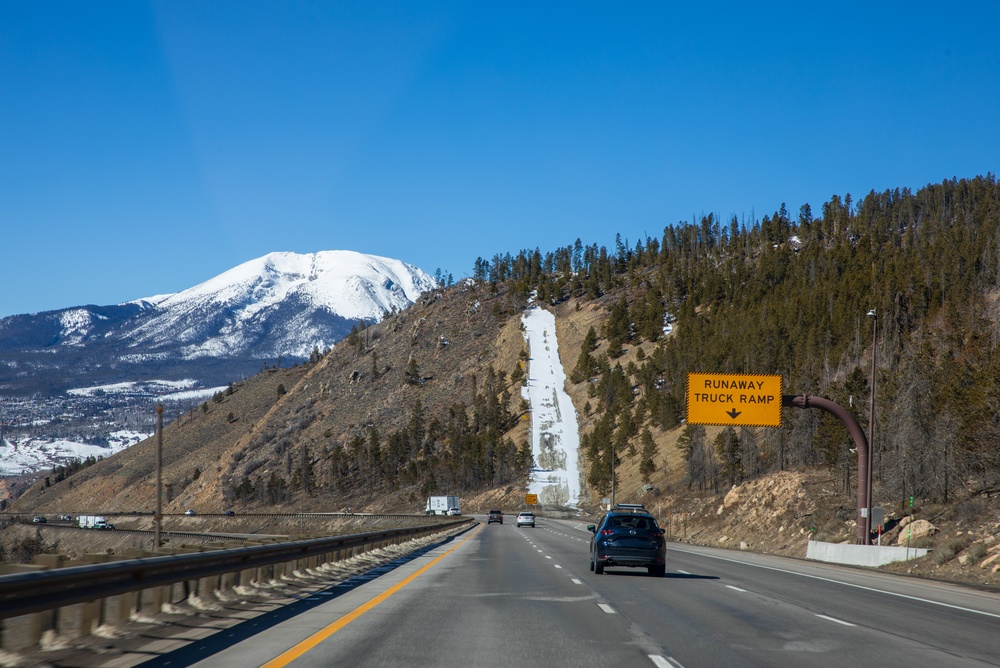
CDOT reports that runaway truck ramps are used most frequently in summer, which points toward brake condition and driver technique rather than weather.
The Lower Straight Creek ramp on westbound I-70 near Mile Point 212 is the most heavily used runaway truck ramp in the United States, according to CDOT.
Heavy truck brakes fail on long descents because extensive use generates heat faster than the system can shed it. That is a predictable and preventable process, not an act of God.
Liability usually turns on maintenance, load weight, and driver training, all of which are carrier decisions.
Proving one of these cases requires physical inspection of the brakes, which is impossible once the truck is repaired or scrapped.
Why do truck brakes fail on Colorado descents?
Truck brakes fail on long descents because of heat. CDOT explains the mechanism directly in its Truck Safety Campaign fact sheet: long descending grades can result in high vehicle speeds, and heavy truck brakes can overheat and fail through extensive use.
The physics are unforgiving. A loaded tractor-trailer descending a sustained grade is converting an enormous amount of potential energy into heat, and the service brakes are the component absorbing it. A driver who rides the brakes instead of controlling speed with engine braking and gear selection will eventually reach a point where the brakes stop generating friction. From there, the vehicle accelerates and the driver has no meaningful way to stop it.
CDOT’s own guidance to drivers reflects this. The agency tells commercial operators not to be afraid to use brake check areas and runaway truck ramps, and its campaign message is slow, steady, and safe for the long haul.
Why does it matter that ramp use peaks in summer?
Because it removes the weather excuse from the case. CDOT reports that runaway truck ramps are used most frequently in summer.
In a personal injury claim, defense counsel routinely characterizes a mountain crash as the product of conditions nobody could control. When the state’s own transportation agency reports that the ramps see their heaviest use during dry, clear months, that framing collapses. What is left is the set of decisions a company made: how the brakes were maintained, how heavily the truck was loaded, and whether the driver was trained for the route.
CDOT also reports that Colorado has five runaway truck ramps along the I-70 Mountain Corridor, and that the Lower Straight Creek ramp on westbound I-70 near Mile Point 212 is the most heavily used runaway truck ramp not only in Colorado but in the United States. A carrier operating on that corridor cannot claim the risk was unknown.
What causes the underlying brake failure?
Several causes appear repeatedly, and they tend to point in different directions when assigning responsibility.
Brakes out of adjustment. Air brake systems require periodic adjustment, and a system out of spec does less work per axle, which loads the remaining brakes.
Worn linings or drums. Deferred replacement is a maintenance decision, and it shows in the records.
Overloading. A truck carrying more weight than it should generates more heat on the same grade, which connects to the shipper and loader as potential defendants.
Improper descent technique. Riding the service brakes rather than descending in the appropriate gear, which is a training issue.
Component defect. A part that failed because it was defectively designed or manufactured becomes a defective products claim.
Missed inspection findings. A defect that a pre-trip inspection should have caught, or that a maintenance contractor was hired to find and did not.
That finding is about the carrier, not the driver. A company that assigns a newly qualified driver to a Colorado mountain route without training on grade descent, gear selection, brake cooling, and ramp locations has made a choice about a documented risk. Colorado’s Mountain Rules campaign, developed by CDOT with the Colorado Motor Carriers Association and Colorado State Patrol, exists to give carriers that information, and CDOT materials describe in-cab alert systems that notify drivers of steep grades, runaway ramp locations, and brake check areas.
Through physical inspection of the vehicle combined with the carrier’s records, and the physical piece cannot be recreated later.
A qualified inspection can establish:
Brake adjustment across every axle at the time of the crash
Lining thickness, drum condition, and evidence of heat damage
Air system integrity and leaks
Whether the trailer brakes were contributing or the tractor was doing the work alone
Actual axle weights against legal limits
The records fill in the rest: maintenance and repair history going back well before the crash, prior inspection reports and out-of-service orders, the driver qualification and training file, dispatch and route assignment records, and the bill of lading establishing load weight.
Engine data adds the final layer, showing speed on the descent, throttle input, and whether the driver attempted engine braking. Our guide on what truck black box and ELD data shows after a crash covers what those systems record.
Why does timing matter so much in these cases?
Because a brake failure claim depends on inspecting brakes, and a truck that has been repaired or salvaged takes the answer with it. Once new linings are installed, nobody can establish what the old ones looked like.
The paper trail runs out too. Federal regulation 49 CFR 395.8(k)(1) requires motor carriers to retain records of duty status and supporting documents for only six months from the date of receipt. Colorado allows three years to file most motor vehicle personal injury claims, which means the evidence can lawfully disappear while the filing deadline is still two and a half years away.
A written preservation demand sent to the carrier and its insurer is what holds the vehicle and the records in place. The mechanics are covered in preserving evidence after a Colorado truck crash.
What injuries do these crashes cause?
Some of the most severe injuries in the entire category, because a runaway truck is traveling faster than a truck involved in almost any other crash type and cannot slow down before impact.
Injury patterns include traumatic brain injury, spinal cord injury and paralysis, multiple orthopedic fractures, internal organ damage, crush injuries, and burns where fuel is involved. Fatal outcomes become wrongful death claims brought by surviving family members.
Because these injuries are frequently permanent, the damages analysis extends well past current medical bills into future care, home modification, and lost earning capacity. That is also why available insurance matters so much, which is covered in why truck insurance is different from car insurance.
What if the runaway vehicle was a government truck?
Public agencies operate heavy vehicles on the same grades, and a crash involving one runs under the Colorado Governmental Immunity Act rather than ordinary tort rules.
Written notice must reach the correct public entity within 182 days of discovering the injury under C.R.S. 24-10-109, and recovery is capped by statute regardless of the severity of the injury. Our article on injured by a government vehicle in Colorado covers the notice requirements and current limits.
Is brake failure a defense for the trucking company?
Rarely. Brake failure on a long descent is a foreseeable consequence of extensive brake use, and the relevant questions become whether the brakes were properly maintained, whether the truck was overloaded, and whether the driver was trained for the route.
How many runaway truck ramps does Colorado have on I-70?
CDOT reports five runaway truck ramps along the I-70 Mountain Corridor. The Lower Straight Creek ramp on westbound I-70 near Mile Point 212 is the most heavily used in the United States.
Why are truck ramps used more in summer?
CDOT reports that ramp use peaks in summer because long descending grades cause brake systems to overheat through extensive use, a mechanism that does not depend on snow or ice.
Can I still bring a claim if the truck has already been repaired?
Possibly. Maintenance records, prior inspection reports, load documentation, and engine data may still be available, and law enforcement inspection findings from the scene can be significant. It is worth having the case reviewed rather than assuming it is too late.
Who inspects the truck’s brakes after a crash?
An independent expert retained for the case, typically under a protocol negotiated with the carrier so that both sides can be present and the evidence is not altered.
Talk to a Denver truck accident lawyer
Brake failure cases are won by inspecting the truck before it goes back into service. Chalat Hatten & Banker represents seriously injured people and their families throughout Colorado on a contingency fee basis, and when you call you reach a partner of the firm. Schedule a free consultation.
Colorado’s Must Carry Chain Law requires commercial vehicles to carry chains or approved traction devices from September 1 through May 31, whether or not it is snowing that day.
CDOT reports that the law covers more than 1,400 centerline miles of highway and that law enforcement issued over 1,300 Must Carry citations during the 2024-2025 chain season.
A violation is not just a fine. In a personal injury case it is evidence that the carrier disregarded a known, published requirement.
Two separate failures matter: not carrying the equipment at all, and carrying it but failing to install it when the chain law was activated.
Because these violations are decisions made before the truck ever left the yard, they usually point at the motor carrier rather than only the driver.
What is Colorado’s chain law?
Colorado’s chain law is really two requirements: a carrying requirement that applies for most of the year, and an activation requirement that applies when conditions call for it.
Under Senate Bill 24-100, commercial motor vehicles must carry chains from September 1 through May 31. The requirement covers I-70 between Dotsero and Morrison and most state and federal highways west of I-25, and it applies regardless of the weather on any given day. A clear, dry September morning does not excuse an empty chain rack.
Separately, CDOT can activate the Commercial Vehicle Chain Law on any state highway when conditions require it. Once activated, vehicles at or above the applicable weight threshold must have chains installed on the required number of drive tires.
How is the commercial chain law different from the traction law?
They apply to different vehicles and impose different requirements, which matters when identifying what a specific truck was obligated to do.
Traction Law
Commercial Vehicle Chain Law
Applies to
Drivers not operating a commercial motor vehicle
Commercial motor vehicles
Requirement
Winter, all-weather, or M+S tires with at least 3/16-inch tread, or chains or an approved alternative traction device
Chains or approved alternative traction devices installed on drive tires
I-70 corridor timing
September 1 through May 31 between Dotsero and Morrison
Carrying requirement September 1 through May 31; installation when activated
CDOT has also noted that Colorado’s updated Traction Law requires the tread depth and tire type described above for all four-wheel-drive and all-wheel-drive vehicles. Passenger vehicle drivers who want the practical version can see our winter driving safety tips.
Does a chain law violation prove the trucking company was negligent?
It does not decide the case by itself, but it is unusually strong evidence, because the requirement is published, specific, and known to every carrier operating in the state.
In any Colorado personal injury case, an injured person must prove negligence by establishing a duty, a breach, causation, and damages. A safety statute supplies the duty in writing and makes the breach concrete. The remaining question is causation: did the missing traction actually contribute to the crash?
That question is answerable with physical evidence. Skid and yaw marks, the crash geometry, road surface condition at the time, CDOT closure and condition records, and engine data showing wheel speed and braking all speak to whether traction was the operative failure. Our guide on what truck black box and ELD data shows after a crash covers what the vehicle itself recorded.
Who is responsible when a truck lacks required chains?
Usually the motor carrier, and often more clearly than the driver. Equipment is a company decision made before dispatch, not a judgment call made at 65 miles per hour.
The relevant questions in a claim are:
Did the carrier equip the truck with chains before sending it into the covered area?
Did the carrier train the driver on when and how to install them?
Did the carrier’s schedule leave time for a chain-up stop at a designated station?
Did dispatch pressure the driver to continue through an activated chain law?
Does the carrier have a history of chain law citations?
A delivery window that cannot accommodate a chain-up stop is a scheduling decision, and it belongs to the company. This is the same category of direct carrier negligence covered in who is liable in a truck accident besides the driver, and it does not depend on whether the driver was an employee or an owner-operator.
What if the driver had chains but did not use them?
That is a separate failure, and it can be a worse one. Carrying chains and choosing not to install them when the chain law was active reflects a decision made with the equipment in hand.
Timing evidence resolves this. CDOT records establish when the chain law was activated and on which segment. Duty logs and GPS data establish where the truck was and whether it passed a designated chain station without stopping. Chain stations exist precisely because installing chains in a live lane of traffic is itself dangerous, so a driver who passed several of them made a series of choices rather than one.
Schedule pressure often sits underneath that choice, which loops back to the carrier and connects to the same records that prove hours of service violations.
How does the defense respond to a chain law violation?
Three arguments come up repeatedly, and each can be met with evidence rather than assertion.
The chain law was not active at that moment. CDOT activation records and time-stamped road condition data settle this.
Chains would not have prevented the crash. This is a causation argument and it is answered by reconstruction, surface condition analysis, and the crash geometry.
The injured driver contributed to the crash. This is the most common approach in every commercial case. Under Colorado’s modified comparative negligence rule, an injured person found 50 percent or more at fault recovers nothing, so shifting blame is not a discount for the insurer, it is a complete defense.
The records that answer all three are held by the carrier and by CDOT, and the carrier’s portion has a short life. Federal rules require only six months of retention for duty records. The steps involved are covered in preserving evidence after a Colorado truck crash.
Do chain violations only matter in winter?
The chain law itself is seasonal, but the broader assumption that Colorado truck crashes are a winter problem does not hold up. CDOT’s Truck Safety Campaign fact sheet reports that runaway truck ramps are used most frequently in summer, because long descending grades cause heavy truck brakes to overheat and fail through extensive use.
Public plows and maintenance trucks operate throughout the covered highways, and a crash involving one runs under the Colorado Governmental Immunity Act. C.R.S. 24-10-109 requires written notice to the correct public entity within 182 days of discovering the injury, and missing that deadline bars the claim.
When does Colorado’s chain law apply to commercial vehicles?
Commercial motor vehicles must carry chains from September 1 through May 31 on I-70 between Dotsero and Morrison and most state and federal highways west of I-25. Installation is required when CDOT activates the Commercial Vehicle Chain Law.
Does a truck have to carry chains even when there is no snow?
Yes. The Must Carry requirement applies throughout the season regardless of current weather conditions.
Can a chain law citation be used in my injury case?
A citation is one piece of evidence. The stronger showing usually comes from the underlying facts, including CDOT activation records, the truck’s location and equipment at the time, and the carrier’s compliance history.
Is the driver or the company responsible for missing chains?
Often both, but equipping the truck is a company decision made before dispatch, which frequently places the stronger claim against the motor carrier.
How do I prove the chain law was in effect when I was hit?
CDOT maintains records of when and where chain law restrictions were activated, and those records can be obtained as part of building the claim.
Talk to a Denver truck accident lawyer
A missing set of chains is a decision someone made, and the records showing who made it do not last long. Chalat Hatten & Banker represents seriously injured people and their families throughout Colorado, and there is no fee unless we recover on your behalf. Schedule a free consultation.
I-70 is the only east-west interstate in Colorado, and CDOT reports that commercial vehicles account for roughly 10 percent of traffic on it.
Colorado State Patrol has found that 65 percent of drivers who used an I-70 runaway truck ramp had five years or less of driving experience.
Corridor crashes are rarely explained by weather alone. Driver experience, route assignment, brake maintenance, and load weight are usually the operative facts in an injury claim.
“The mountains are dangerous” is a defense argument, not a fact. Colorado law asks whether a specific carrier made reasonable decisions about a known and documented risk.
Corridor crashes often produce catastrophic injuries because impact speeds are high and vehicle weights are extreme.
What makes the I-70 corridor different?
The corridor combines sustained grades, high elevation, tight curves, and weather that changes within a single hour, on the only east-west interstate the state has. Freight cannot simply choose a different route.
CDOT describes Colorado’s mountain highways as uniquely challenging because of steep grades, unpredictable weather, and heavy snow, and notes that commercial vehicles have a larger footprint on the roadways where chains are required. The agency reports that commercial vehicle traffic accounts for roughly 10 percent of vehicles on I-70.
The corridor’s specific pressure points are familiar to anyone who drives it: the descent from the Eisenhower Tunnel toward Silverthorne, Vail Pass, the Georgetown and Idaho Springs stretch, and the eastbound descent from Floyd Hill into the Denver metro. Each one is a sustained grade where a heavy vehicle’s brakes do work they were never designed to do continuously.
Are these crashes caused by weather?
Less often than the defense would like a jury to believe, and the data undercuts the assumption directly.
CDOT’s Truck Safety Campaign fact sheet reports that runaway truck ramps are used most frequently in summer. It also explains why: long descending grades let vehicle speeds build, and heavy truck brakes can overheat and fail through extensive use. That is a mechanical and operational problem, not a snow problem.
The same fact sheet identifies the Lower Straight Creek runaway truck ramp on westbound I-70 near Mile Point 212 as the most heavily used runaway truck ramp not only in Colorado but in the United States.
This matters in a personal injury case because it removes the excuse. When a carrier argues that mountain conditions caused an unavoidable crash, the response is that the conditions were known, published, and the subject of a state safety campaign aimed specifically at trucking companies.
That statistic goes straight to the carrier rather than the driver. A company that assigns a newly qualified driver to a Colorado mountain route without training on grade descent, gear selection, brake cooling, and ramp locations has made a decision about a documented risk. That is the foundation of a negligent training and negligent assignment claim, and it is one of the theories covered in who is liable in a truck accident besides the driver.
CDOT and the Colorado Motor Carriers Association developed the Mountain Rules campaign specifically to educate trucking companies and drivers about these challenges, and CDOT’s materials describe in-cab alert systems that notify drivers of steep grades, runaway ramp locations, and brake check areas. A carrier that declined available tools designed for exactly this corridor has to explain that choice.
What kinds of truck crashes happen on the corridor?
The patterns are distinct from urban commercial crashes, and each points toward a different set of facts in a claim.
Lane restrictions are worth noting on their own. Colorado law restricts commercial motor vehicles from operating in the left lanes on portions of the I-70 mountain corridor where curves or steep grades exist. A truck that was where it should not have been is a fact a jury understands immediately.
Why are corridor injuries so severe?
Because the energy involved is greater. A loaded tractor-trailer descending a 6 percent grade carries momentum that a passenger vehicle cannot absorb, and the resulting injuries tend to be permanent rather than temporary.
Common injury patterns include traumatic brain injury, spinal cord injury and paralysis, multiple orthopedic fractures, internal organ damage, crush injuries, and burns where fuel is involved. Fatal outcomes become wrongful death claims brought by the family.
Corridor geography compounds the harm. Emergency response takes longer at elevation and on a closed highway, and the nearest trauma center may be an hour or more away by ground. Delayed definitive care can worsen outcomes in ways that become part of the damages picture rather than a defense to it.
Psychological injury is common as well, particularly among people who watched a family member injured or killed. Our discussion of PTSD and emotional trauma after an accident covers how those claims are documented.
What evidence matters in a corridor crash claim?
The same records that matter in any commercial case, plus several that are specific to mountain driving.
Engine and brake data. Speed and braking on the descent, plus fault codes indicating a known mechanical problem. Our guide on what truck black box and ELD data shows after a crash covers what these systems capture.
Brake inspection and maintenance records for the tractor and trailer, going back well before the crash date.
Load weight and securement documentation. An overweight truck generates more brake heat on the same grade.
Driver qualification and training records, specifically whether the driver received mountain grade training.
Route assignment and dispatch records, showing who chose the corridor and what deadline applied.
Traction device compliance at the time of the crash.
CDOT road condition and closure records for the relevant window.
All of it has a shelf life. Federal rules require carriers to keep duty records for only six months, and a tractor returned to service may lose its crash data entirely. The steps involved are covered in preserving evidence after a Colorado truck crash.
What if the crash involved a CDOT vehicle?
Then a different deadline governs the claim, and it is far shorter than the ordinary one. Plows, sanders, and maintenance trucks operate throughout the corridor, and a crash involving one falls under the Colorado Governmental Immunity Act.
C.R.S. 24-10-109 requires written notice to the correct public entity within 182 days of discovering the injury, and recovery is capped by statute. Our article on injured by a government vehicle in Colorado covers the notice requirements and the current limits.
What should drivers sharing the corridor know?
Nothing a passenger vehicle driver does eliminates the risk created by a poorly maintained truck, but a few habits improve the odds in the moments that matter.
Leave more following distance behind a truck on a descent than feels necessary. A truck that loses braking cannot stop, and the space in front of you is the only margin available.
Avoid lingering alongside a trailer on a curve. Rollover and lane departure happen faster than a lane change can be completed.
Treat brake check areas and ramp signage as information about where trucks are struggling.
Check CDOT conditions before entering the corridor rather than after.
CDOT reports five runaway truck ramps along the I-70 Mountain Corridor. The Lower Straight Creek ramp on westbound I-70 near Mile Point 212 is the most heavily used runaway truck ramp in the United States.
Are truck ramps used more in winter?
No. CDOT reports that runaway truck ramps are used most frequently in summer, because long descending grades cause brakes to overheat through extensive use regardless of weather.
Can a trucking company blame the crash on mountain conditions?
It can argue that, but the conditions on I-70 are published, well documented, and the subject of a state safety campaign directed at carriers. A company that knew about a risk and did not train or equip for it has a difficult argument.
Can trucks drive in the left lane on I-70?
Colorado law restricts commercial motor vehicles from the left lanes on portions of the I-70 mountain corridor where curves or steep grades exist.
Does it matter that I am from out of state?
No. A crash that happens in Colorado is generally handled under Colorado law regardless of where the injured person lives, and many corridor crashes involve visitors.
Talk to a Denver truck accident lawyer
Corridor crash cases are won on records the carrier controls, and those records do not last. Chalat Hatten & Banker represents seriously injured people and their families throughout Colorado on a contingency fee basis. Schedule a free consultation.
Colorado requires drivers to carry only $25,000 per person in bodily injury liability coverage. Federal law requires most interstate freight carriers to carry at least $750,000.
That $750,000 minimum was set by the Motor Carrier Act of 1980 and has never been raised, which means it buys far less medical care today than it did then.
Serious injury claims frequently exceed the primary policy, which is why commercial coverage is usually layered across several insurers.
A larger policy is not a larger offer. Commercial insurers defend these claims aggressively precisely because the exposure is high.
When a public entity owns the vehicle, damages are capped by statute regardless of how much coverage exists.
How much insurance does a commercial truck have to carry?
Federal minimums are set in 49 CFR 387.9, and the required amount depends on what the truck is hauling.
Type of carriage
Federal minimum
For-hire interstate, nonhazardous property, 10,001 lbs GVWR or more
$750,000
Oil and certain hazardous materials and wastes in bulk
$1,000,000
Hazardous substances in cargo tanks, portable tanks, or hopper vehicles, and certain explosives
$5,000,000
Compare that to what Colorado asks of an ordinary driver. According to the Colorado Division of Insurance, the required minimum is $25,000 per person for bodily injury, $50,000 per accident, and $15,000 for property damage. Uninsured and underinsured motorist coverage is optional and is included in a policy unless the driver rejects it in writing.
The gap between $25,000 and $750,000 is the single biggest structural difference between a car crash claim and a commercial claim. It changes how the case is investigated, how it is defended, and how long it takes.
Why does the $750,000 minimum matter so much?
Because it was set in 1980 and has never been increased. Congress established the figure through the Motor Carrier Act of 1980, and the regulation still carries it today.
A single hospitalization following a serious truck crash can consume a substantial portion of that amount before rehabilitation begins. Add surgical care, a period of inpatient rehabilitation, home modification, and lost earning capacity, and the primary policy stops being a ceiling on the injury and starts being a starting point for the claim.
This is why the size of the injury, not just the fact of it, drives strategy in commercial cases. Catastrophic injuries such as traumatic brain injury and spinal cord damage are the ones that routinely exceed the minimum, and they are also the injuries most commonly produced by an 80,000-pound vehicle.
What does a commercial insurance tower look like?
Commercial coverage is usually layered rather than sitting in a single policy. A carrier buys a primary policy and then stacks excess layers on top of it, sometimes through several different insurers.
A typical structure looks like this:
Self-insured retention. An amount the carrier pays out of pocket before any insurer contributes.
Primary layer. The policy that responds first and controls the initial defense.
Excess layers. Additional coverage that attaches once the layer beneath it is exhausted.
The layering changes negotiation. Each insurer wants the case resolved within the layer below its own, which means a demand that exceeds the primary policy forces excess carriers into the conversation. Those carriers evaluate the claim independently, and they pay close attention to whether the case is likely to be tried.
The MCS-90 is a federally required endorsement attached to a motor carrier’s liability policy. Its purpose is to make sure the public is protected even when the underlying policy would otherwise exclude the claim.
In practical terms, it functions as a backstop rather than as ordinary coverage. The insurer that pays under an MCS-90 generally has the right to seek reimbursement from the carrier. For an injured person, its significance is that a coverage exclusion buried in a commercial policy does not automatically leave them with nothing.
Whether it applies in a given case is a legal question that turns on the specific facts, the type of commerce involved, and the policy language. It is worth having counsel evaluate rather than assuming it either applies or does not.
Does more insurance mean a bigger settlement?
No, and expecting otherwise leads to disappointment. A larger policy means larger exposure, and larger exposure means a more determined defense.
Commercial insurers behave differently from personal auto insurers in several observable ways:
They deploy investigators to serious crash scenes within hours, sometimes before the vehicles have been cleared.
They retain defense counsel immediately rather than after a claim is filed.
They invest heavily in comparative fault, because every percentage point assigned to the injured person reduces what they pay.
That last point is worth dwelling on. Under Colorado’s modified comparative negligence rule, an injured person found 50 percent or more at fault recovers nothing at all. Against a $750,000 policy, moving fault from 30 percent to 50 percent is not a discount for the insurer. It is a complete defense.
How do commercial adjusters value a truck injury claim?
On the same core variables as any personal injury claim, with one addition. Medical expenses, future care, lost income, lost earning capacity, permanence, and the strength of the liability evidence all drive the number, as covered in how insurance adjusters decide what your claim is worth.
The addition is trial risk. When a carrier’s exposure runs into seven figures, the insurer’s evaluation includes whether the firm on the other side actually tries cases or settles them. That assessment is not speculation on our part. It is discussed openly in the industry, and our article on why insurance companies track which law firms actually go to trial explains how it shows up in an offer.
What if the truck was uninsured or underinsured?
It happens, particularly with small carriers, unregistered operators, and hit-and-run cases where the truck is never identified.
Colorado drivers who carry uninsured and underinsured motorist coverage can pursue their own policy in those situations. Because UM and UIM coverage is included unless it was rejected in writing, many people have it without realizing. Our guide to uninsured motorist claims after a Colorado crash covers how those claims work, and our page on hit and run accidents addresses the situation where the vehicle leaves the scene.
What if a government vehicle was involved?
Then insurance limits stop being the ceiling and statute takes over. Public entities in Colorado are shielded by the Colorado Governmental Immunity Act, which caps recovery regardless of available coverage.
For claims accruing on or after January 1, 2026 and before January 1, 2030, the Colorado Secretary of State’s certified limitation on judgments is $505,000 for injury to one person in a single occurrence and $1,421,000 where two or more people are injured, with no individual recovering more than $505,000.
There is also a hard notice deadline. C.R.S. 24-10-109 requires written notice to the correct public entity within 182 days of discovering the injury. The details are covered in injured by a government vehicle in Colorado.
Do I pay anything to pursue a truck insurance claim?
Not upfront. Personal injury firms in Colorado generally work on a contingency fee, meaning the fee comes out of a recovery and there is nothing owed if there is no recovery.
That structure matters more in commercial cases than in ordinary claims, because the costs are higher. Downloading engine data, retaining an accident reconstruction expert, hiring a trucking safety expert, and building a life care plan are expensive. A firm that advances those costs is making a judgment about the case. Our explanation of how contingency fees work covers the arrangement in detail.
Federal law requires most for-hire interstate carriers hauling nonhazardous property to maintain at least $750,000 in liability coverage. Trucks carrying hazardous substances in cargo tanks must carry $5,000,000. Many carriers hold considerably more through excess layers.
Will the trucking company’s insurer offer more because the policy is large?
No. A larger policy generally produces a more aggressive defense, not a more generous offer, because the insurer’s exposure is greater.
What happens if my damages exceed the truck’s insurance?
Excess layers may apply, and additional responsible parties such as a shipper, broker, maintenance contractor, or manufacturer may bring separate coverage. Your own underinsured motorist coverage may also be available.
Does Colorado require uninsured motorist coverage?
No. The Colorado Division of Insurance describes uninsured and underinsured motorist coverage as optional, though it is included in a policy unless the driver rejects it in writing.
Is there a cap on what I can recover in a truck accident case?
Not for claims against private carriers. Claims against public entities are capped by the Colorado Governmental Immunity Act at the amount certified by the Secretary of State for the year the claim accrued.
Talk to a Denver truck accident lawyer
Finding every available layer of coverage is part of building the claim, and it starts with identifying every responsible party. Chalat Hatten & Banker represents seriously injured people and their families throughout Colorado, and there is no fee unless we recover on your behalf. Schedule a free consultation.
In most serious commercial crashes, more than one party shares responsibility, and the driver is often the least able to pay.
A motor carrier can be liable two ways: for the driver’s conduct, and for its own decisions about hiring, training, scheduling, and maintenance.
Shippers, cargo loaders, maintenance contractors, brokers, and parts manufacturers can each carry a share of the fault depending on what failed.
Identifying every responsible party early matters because each one brings a separate insurance policy to the table.
When a public entity owns the vehicle, a completely different set of deadlines and damage limits applies.
Why does it matter who else is liable?
It matters because a personal injury claim is only worth what someone can actually pay. An injured person with $900,000 in medical bills and a permanent disability gains nothing from a judgment against a driver with no assets.
Commercial crashes almost always involve businesses with real insurance behind them, and each additional responsible party adds a policy. That is the practical reason the defendant list gets built carefully at the beginning of a case rather than after a demand letter has already gone out.
There is a legal reason too. Colorado divides fault among the parties involved, and under Colorado’s modified comparative negligence rule an injured person recovers nothing if found 50 percent or more at fault. Leaving a responsible company out of the case can concentrate blame on the injured person by default.
How can the trucking company be liable?
A motor carrier can be liable in two distinct ways, and the difference matters enormously when the driver was not an employee.
For the driver’s negligence. When a driver is an employee acting within the scope of employment, the carrier answers for what the driver did. This is the straightforward path, and carriers sometimes concede it in order to keep their own conduct out of evidence.
For the carrier’s own negligence. This theory does not depend on the employment relationship at all. It asks what the company decided, and the answers often turn out to be more damaging than anything the driver did.
Negligent hiring. Putting a driver on the road with a history of violations, a suspended license, or a failed drug test.
Negligent training. Assigning a new driver to Colorado mountain routes without training on descending grades and brake management.
Negligent supervision and retention. Ignoring log violations flagged by the carrier’s own compliance software, or keeping a driver after repeated incidents.
Negligent scheduling. Building a delivery window no compliant driver could meet, which makes hours of service violations the predictable outcome rather than an individual failure.
Negligent maintenance. Deferring brake, tire, or lighting repairs to keep a unit earning.
The carrier can still be responsible. Many trucks on the road are owned by the driver and leased to a motor carrier, and defense counsel frequently argues that the driver was an independent contractor rather than an employee.
Federal leasing rules complicate that argument. A carrier that puts its operating authority on a truck exercises control over how that truck is used, and the direct negligence theories described above never depended on employment status in the first place. A carrier that assigned a route, set a delivery deadline, and did not verify the driver’s qualifications made those choices regardless of what the lease says.
Determining the actual arrangement requires the lease agreement, the driver qualification file, and dispatch records. None of those are available without a claim.
Can a shipper or cargo loader be responsible?
Yes, when the load itself caused or worsened the crash. Federal cargo securement rules place responsibility on whoever loaded and secured the freight, and a driver cannot always see a problem from the cab.
Cargo-related failures show up in several patterns:
Shifting loads that destabilize the trailer during a turn or a lane change
Overloading beyond weight limits, which extends stopping distance and increases brake heat on a descending grade
Improper weight distribution that contributes to rollover or jackknife
Unsecured freight that falls into traffic
Undeclared hazardous materials that turn a survivable crash into a chemical exposure
What about maintenance companies and parts manufacturers?
Both can be defendants when the failure was mechanical rather than behavioral.
Third-party maintenance shops. Many carriers outsource repair work. A shop that performed a brake job improperly, cleared an inspection it should have failed, or missed a defect it was hired to find can be liable for the resulting crash.
Manufacturers. When a component fails because it was defectively designed or built, the claim becomes a defective products claim against the manufacturer. Brake systems, tires, steering components, and underride guards have all been the subject of product litigation.
Distinguishing a maintenance failure from a design defect usually requires physically inspecting the component, which is another reason the vehicle needs to be held rather than repaired.
Can a freight broker be held liable?
Sometimes, and the theory is worth investigating in cases where the primary carrier’s insurance is inadequate.
A freight broker arranges transportation but does not own trucks. The negligence theory is negligent selection: the broker chose a carrier with a poor safety record, an inadequate insurance filing, or no authority to haul the load at all. Federal safety data on carriers is publicly available, so a broker who did not check made a choice.
Broker liability is a contested area of law and outcomes vary. It is a theory to evaluate, not one to assume.
What if the truck belonged to a government agency?
Then the analysis changes completely, and the most important difference is the deadline. Under C.R.S. 24-10-109, an injured person must file written notice of the claim with the correct public entity within 182 days of discovering the injury. Sending it late or sending it to the wrong entity bars the claim.
Recovery is also capped rather than open-ended. For claims accruing on or after January 1, 2026 and before January 1, 2030, the Colorado Secretary of State’s certified limitation on judgments is $505,000 for injury to one person in a single occurrence and $1,421,000 where two or more people are injured.
This is why photographing the truck’s markings at the scene matters so much. Our checklist on what photos to take after a crash covers the specific shots that make identification possible weeks later.
Does adding defendants slow the case down?
It can add time, and that tradeoff deserves an honest answer. More parties means more discovery, more depositions, and more scheduling.
What it buys is access to enough insurance to cover an actual lifetime of care, and protection against a defense strategy that assigns fault to an empty chair. In a catastrophic injury case, the delay is usually worth it. In a moderate injury case with one clearly responsible carrier and adequate coverage, it may not be. Our article on how long a personal injury case takes in Colorado sets realistic expectations either way.
Can I sue the trucking company if the driver was an independent contractor?
Often yes. Direct negligence theories such as negligent hiring, training, scheduling, and maintenance do not depend on an employment relationship, and federal leasing rules can place responsibility on the carrier whose authority the truck was operating under.
How do I find out who owned the truck?
The USDOT number displayed on the vehicle identifies the motor carrier, and federal registration records connect that number to the company, its insurance filing, and its safety history.
Can more than one company be responsible for the same crash?
Yes. Colorado allocates fault among the parties involved, and a single crash can involve a driver, a carrier, a maintenance contractor, and a manufacturer, each with a separate percentage and a separate policy.
Does naming more defendants increase what I recover?
It can, because each responsible party brings its own insurance. It also protects against a defense strategy that blames a party who is not in the case.
What if a government snowplow or bus caused the crash?
The Colorado Governmental Immunity Act applies. Written notice must reach the correct public entity within 182 days of discovering the injury, and recovery is capped at the amount certified by the Secretary of State for the year the claim accrued.
Talk to a Denver truck accident lawyer
Building the full list of responsible parties takes records that only become available once a claim is underway. Chalat Hatten & Banker represents seriously injured people and their families throughout Colorado on a contingency fee basis, and when you call you reach a partner of the firm. Schedule a free consultation.
Federal regulation 49 CFR 395.8(k)(1) requires motor carriers to retain records of duty status and supporting documents for six months from the date of receipt. After that, destruction is lawful.
Colorado gives three years to file most motor vehicle personal injury claims, but the evidence that proves a truck case can lawfully disappear in month seven.
A written preservation letter, sent to the carrier and its insurer, is what stops the clock on destruction.
Physical evidence carries its own deadline. A repaired or salvaged tractor cannot be inspected for brake condition, tire wear, or lighting failure.
There is evidence an injured person controls too, including photographs, medical documentation, and a record of how the injury has affected daily life.
Why does evidence disappear so quickly in truck cases?
Evidence disappears quickly in truck cases because federal retention periods are short and the vehicle is a working asset the carrier wants back on the road. Neither of those pressures exists in an ordinary two-car collision.
The clearest example is the duty log. Under 49 CFR 395.8(k)(1), a motor carrier must retain records of duty status and supporting documents for not less than six months from the date of receipt. That is a floor, not a ceiling, and many carriers keep records longer. But a carrier that destroys them at the six-month mark has done nothing wrong under the regulation.
Compare that to the filing deadline. Colorado allows three years to bring most personal injury claims arising from the use or operation of a motor vehicle under C.R.S. 13-80-101(1)(n). An injured person who takes a year to decide whether to pursue a claim may find the proof gone while the deadline is still eighteen months away.
What records matter in a truck crash claim?
The records that matter are the ones that reconstruct what the driver and the carrier were doing before the crash, not just what happened at the moment of impact.
Supporting documents. Federal rules define these to include bills of lading, dispatch records, trip reports, fuel purchase receipts, toll records, and driver communications. They corroborate or contradict the log, and their independence from the carrier’s own paperwork is what makes them valuable.
Maintenance and inspection files. These show whether a known defect went unrepaired, which moves a claim from driver error toward carrier negligence.
Driver qualification files. Employment history, license status, medical certification, and prior violations speak to negligent hiring and retention.
Drug and alcohol testing records. Federal rules require post-accident testing in defined circumstances, and the presence or absence of a test is itself informative.
What is a preservation letter and what does it do?
A preservation letter is a written demand sent to the motor carrier and its insurer identifying the specific evidence they must not destroy, alter, or return to service. It converts routine record disposal into a deliberate act with legal consequences.
An effective letter is specific rather than general. It typically identifies:
The crash by date, location, unit number, and driver
Electronic logging device data and any back-up copies
Engine control module and telematics data, with a demand that the module not be read or reset before a joint download
In-cab and forward-facing camera footage
Dispatch messages, bills of lading, fuel and toll records
Maintenance, inspection, and repair records for the tractor and trailer
The driver qualification file and post-accident testing results
The tractor, trailer, and cargo themselves, held in their post-crash condition pending inspection
Federal regulation also prohibits obscuring, defacing, destroying, mutilating, or altering information in a supporting document. That prohibition exists independently of any letter, but a preservation demand makes the carrier’s knowledge of the claim undeniable.
Why does the truck itself need to be inspected?
Because several negligence theories can only be proven by looking at the vehicle, and the window closes as soon as the carrier repairs, sells, or scraps it.
A physical inspection can establish brake adjustment and lining condition, tire tread depth and inflation, lighting and reflector function, trailer coupling condition, and whether the load was secured according to federal cargo rules. In Colorado it can also establish whether the vehicle carried required traction devices, which connects to Colorado chain law violations and truck crash liability.
Brake condition deserves particular attention in Colorado. CDOT’s Truck Safety Campaign fact sheet notes that long descending grades can drive vehicle speeds up and cause heavy truck brakes to overheat and fail through extensive use, and that runaway truck ramps see their heaviest use in summer. A truck that was repaired before inspection takes the answer with it, which is a recurring problem in brake failure and runaway truck ramp crashes in Colorado.
What evidence can an injured person preserve on their own?
More than most people realize, and it starts at the scene when possible. An injured person who is able to document what happened creates a record no carrier can quietly retire.
Photograph the identifiers. The USDOT number, motor carrier name, trailer markings, and license plates on both the tractor and the trailer. These are how the correct defendant is identified weeks later.
Photograph the scene. Vehicle positions, debris, skid marks, road conditions, signage, and weather. Our checklist on what photos to take after a crash covers the shots that hold up.
Collect witness contact information. Witnesses scatter and become unfindable within days.
Seek medical care immediately and keep every record. Gaps in treatment are the most common argument used to discount an injury.
Keep a written record of daily limitations. Contemporaneous notes about pain, sleep, missed work, and activities you can no longer do carry real weight in valuing a claim.
Should you give a statement to the trucking company’s insurer?
Not before speaking with a lawyer. A recorded statement taken while an injured person is medicated, in pain, or still learning the extent of their injuries becomes a permanent document that defense counsel will use for years.
The risk is not that an injured person will lie. It is that they will minimize. Saying “I’m okay” in the first week, before a brain injury or a disc herniation has declared itself, gives the insurer a quote to read back at deposition. Our article on how insurance adjusters decide what your claim is worth covers how early statements factor into valuation.
Commercial carriers move quickly on this. Many deploy an investigator to the scene within hours, and the request for a statement often arrives before the injured person has left the hospital.
Does preservation work differently for government vehicles?
The preservation strategy is the same, but the deadline that governs everything else is much shorter. Under C.R.S. 24-10-109, an injured person must serve written notice of a claim on the correct public entity within 182 days of discovering the injury. Missing that deadline bars the claim entirely, no matter how well the evidence was preserved.
How does preservation affect the value of a personal injury claim?
Directly. A claim supported by engine data, duty logs, and a documented vehicle inspection is a claim the carrier’s insurer has to price against the risk of a verdict. A claim supported only by the injured person’s account is one the insurer can discount, because the proof problem belongs to the plaintiff.
Fault allocation makes this concrete. Under Colorado’s modified comparative negligence rule, an injured person who is found 50 percent or more at fault recovers nothing, and any award is reduced by their assigned percentage. Preserved evidence is what keeps that percentage from drifting upward on the strength of a defense theory nobody can disprove.
How long does a trucking company have to keep driver logs?
Federal regulation 49 CFR 395.8(k)(1) requires motor carriers to retain records of duty status and supporting documents for not less than six months from the date of receipt.
Can I send a preservation letter myself?
You can, but a general letter is easy to comply with narrowly. An effective demand identifies specific systems and records, and it carries more weight coming from counsel who is clearly prepared to litigate.
What happens if the trucking company destroys evidence anyway?
Destruction of relevant evidence after notice of a claim can become an issue in the litigation itself, separate from the underlying negligence question.
Is it too late if the crash happened months ago?
Not necessarily. Some records survive well past the minimum retention period, and other sources such as law enforcement files, medical records, and independent witnesses remain available. It is worth having the case reviewed rather than assuming the window has closed.
Do I have to file a lawsuit to preserve evidence?
No. A preservation demand is sent before any lawsuit is filed. Formal discovery follows later if the claim does not resolve.
Talk to a Denver truck accident lawyer
The six-month clock on a trucking company’s records starts the day of the crash. Chalat Hatten & Banker represents seriously injured people and their families throughout Colorado, and there is no fee unless we recover on your behalf. Schedule a free consultation.
Commercial trucks carry two separate data systems: an engine control module that records vehicle performance, and an electronic logging device that records the driver’s duty status.
The engine module typically captures speed, throttle, brake application, and engine RPM in the seconds surrounding a hard braking event or collision.
This data frequently contradicts a driver’s account, which is why it is often the difference between a disputed liability case and a clear one.
Neither system is preserved automatically. Data can be overwritten when a truck returns to service, and retention periods for duty records are short.
The injured person does not own this data. Getting it requires a preservation demand and, usually, formal legal discovery.
What is a truck black box?
A truck black box is not a single device. The term usually describes the electronic control module, sometimes called the ECM or engine control module, which is the computer that manages the engine and records performance data as a byproduct of doing so.
Depending on the make and configuration, the module may record:
Vehicle speed in the seconds before an event
Throttle position and engine RPM
Service brake application and timing
Use of cruise control
Hard braking and sudden deceleration events
Fault codes indicating a mechanical problem
Total engine hours and idle time
Many fleets add telematics on top of the engine module, and increasingly a forward-facing or driver-facing camera. Those systems can supply GPS position, lane departure warnings, and video of the moments before impact.
How is an ELD different from a black box?
An electronic logging device records the driver’s duty status, while the engine module records what the vehicle was doing. They answer different questions in a personal injury case.
Engine control module
Electronic logging device
Records
Vehicle performance
Driver duty status
Answers
Was the driver speeding? Did the driver brake?
How long had the driver been working?
Used to prove
Speed, reaction, mechanical failure
Hours of service violations and fatigue
Held by
The vehicle
The motor carrier and its ELD vendor
Together they build a single timeline. The ELD shows the driver had been on duty for 15 hours. The engine module shows no brake application in the final four seconds. That combination supports a truck driver fatigue and hours of service violation theory far more effectively than either record alone.
What does this data actually prove in an injury claim?
It proves the facts that liability turns on, and it does so without relying on anyone’s memory. In a personal injury case an injured person must prove negligence, and electronic data speaks to nearly every element.
Speed. A recorded speed of 68 in a posted 55 removes the argument about whether the truck was going too fast for conditions.
Reaction. The absence of brake application is one of the most powerful facts available. A driver who never braked was not watching the road, whatever the reason.
Mechanical condition. Stored fault codes can show a known problem that the carrier failed to repair, which shifts the claim from driver error toward carrier negligence and expands who is liable in a truck accident besides the driver.
Comparative fault. Defense counsel routinely argues that the injured driver braked suddenly, merged unsafely, or sat in a blind spot. Engine data and telematics can test each of those claims. That matters directly under Colorado’s modified comparative negligence rule, where an injured person who is 50 percent or more at fault recovers nothing.
How long does the data survive?
Not long, and the timeline is shorter than most people assume. Three separate risks work against an injured person.
Overwriting. Some engine modules retain only a limited number of events. When the truck returns to service, subsequent hard braking events can push the crash data out of memory.
Repair and salvage. A tractor that is repaired, sold, or scrapped may take its data with it. Physical inspection of brakes, tires, and lighting becomes impossible at the same moment.
Retention periods. Federal rules require carriers to keep certain duty records for a limited period. Once that period passes, destruction is lawful.
This is why the practical deadline in a truck case is measured in weeks, even though Colorado gives three years to file most motor vehicle personal injury claims. The steps involved are covered in preserving evidence after a Colorado truck crash.
How does an injured person get the data?
Through a lawyer, and through a defined legal process. The data belongs to the motor carrier, and no carrier hands it over voluntarily to the person who intends to sue it.
The sequence generally runs like this:
A written preservation demand goes to the carrier and its insurer, identifying the specific records and systems that must not be destroyed or altered.
A download protocol is negotiated so that the module is read by a qualified technician, often with representatives of both sides present, and without altering the stored data.
Formal discovery follows once a claim is filed, reaching ELD records, dispatch messages, maintenance files, and driver qualification files.
Expert analysis interprets the raw output, since manufacturer formats differ and the numbers require context to be meaningful.
When a carrier destroys evidence after being put on notice, that conduct itself can become an issue in the case. Which is another reason the demand goes out in writing and early.
What if the truck belonged to a government agency?
Public entities operate plows, buses, and heavy equipment with the same telematics as private fleets, but the claim runs under different rules. The Colorado Governmental Immunity Act requires written notice to the correct public entity within 182 days of discovering the injury under C.R.S. 24-10-109, and missing that window bars the claim.
Does the data ever hurt the injured person’s case?
Sometimes, and an honest evaluation accounts for that. Telematics can show that a passenger vehicle cut in front of the truck, or that the truck was traveling at a lawful speed with normal braking. A lawyer who reviews the data early can advise a client realistically instead of building a case on an assumption.
That said, the fear of unfavorable data is rarely a reason to avoid seeking it. The carrier will obtain it regardless. An injured person who has not seen it is negotiating blind, and insurers price that disadvantage into their offers. Our article on how insurance adjusters decide what your claim is worth explains how information asymmetry shows up in a settlement number.
Where does this fit in the larger claim?
Electronic data is one piece of a case that also includes medical records, wage documentation, scene evidence, and expert reconstruction. It tends to resolve the liability fight quickly, which then moves the case onto damages. For the full framework, see our overview of truck accident claims in Colorado, and for what an injured person can gather personally, our checklist on what photos to take after a crash.
Frequently Asked Questions
Do all commercial trucks have a black box?
Most modern commercial trucks have an electronic control module that records performance data, though what it captures and for how long varies by manufacturer and configuration. Most interstate carriers are also required to use electronic logging devices for duty status.
Can the trucking company erase the data?
Data can be lost through normal operation, repair, or the expiration of a retention period. Once a carrier receives a written preservation demand, destroying the evidence can itself become an issue in the litigation.
How soon should the data be requested?
Within days. Some modules overwrite crash data as the truck continues in service, and a repaired or sold vehicle may be unavailable for inspection entirely.
Is ELD data enough to prove my case by itself?
Rarely. ELD data establishes how long the driver had been working, but a complete claim also requires evidence of causation and documented damages.
Who pays to have the module downloaded?
In a contingency fee arrangement, the firm typically advances the cost of the download and expert analysis, and is repaid from any recovery.
Talk to a Denver truck accident lawyer
The evidence that proves a commercial crash case is electronic, and it does not wait. Chalat Hatten & Banker represents seriously injured people and their families throughout Colorado on a contingency fee basis. Schedule a free consultation.